

Understanding ISO 8573-1 for Pneumatic Systems
Air Quality Standards: Understanding ISO 8573-1 for Pneumatic Systems
If you manage a maintenance crew or run a busy shop floor, you already know the frustration of unexpected tool failure. A cylinder starts sticking, a valve leaks, or an air motor suddenly loses torque.
You pull it apart, and what do you find? Sludge. Rust. Pitted metal surfaces.
It is easy to blame the tool, but the real culprit is usually invisible: dirty, wet compressed air. Ambient air is packed with dust particles, water vapor, and oily residue from the compressor itself. When compressed, these contaminants concentrate, acting like an abrasive, corrosive slurry that destroys your tools from the inside out.
To protect your equipment, you need the right pneumatic air quality standards in place. That is where ISO 8573-1 classes come into play. Let’s break down this standard into plain English so you can choose the exact filtration your system needs.
What is the ISO 8573-1 Standard?
ISO 8573-1 is the international language of compressed air purity. Instead of using vague terms like “clean enough,” it establishes specific purity classes based on three primary types of contaminants:
- Solid Particles: Dust, pipe scale, and metal flecks.
- Water: Liquid moisture and vapor pressure dewpoint (how cold the air can get before water condenses).
- Oil: Liquid oil, aerosols, and oil vapor.
When you look at a system’s air specification, it is usually written as three numbers separated by colons—for example, ISO 8573-1:2010 [1:2:1]. Each number corresponds to a purity class for particles, water, and oil, in that order. The lower the number, the cleaner the air.
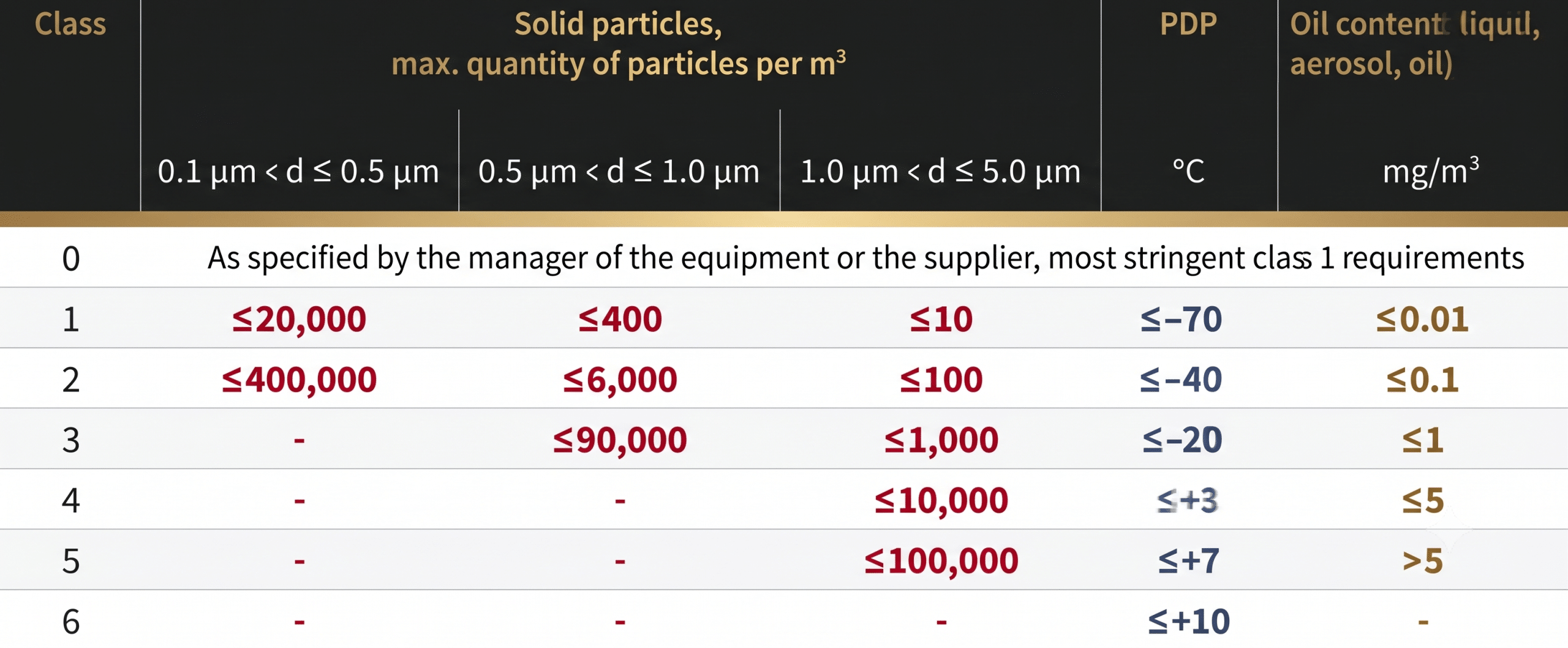
Your Compressed Air Filtration Guide
Not every application requires ultra-pure, sterile air. Over-filtering your air wastes energy and money through unnecessary pressure drops, while under-filtering ruins your equipment.
Use this quick guide to find where your application fits:
1. Plant Air & Robust Tooling (Class 4:4:4 or 3:4:4)
- Applications: Basic assembly tools, impact wrenches, general shop air, and robust cylinders.
- The Target: You want to catch bulk water, larger dust particles, and heavy oil carryover.
- What you need: A standard particulate filter (around 5 to 40 microns) paired with a water separator is usually enough to keep these tools running smoothly without premature wear.
2. High-Performance Automation & Controls (Class 2:4:2)
- Applications: Solenoid valves, precision pneumatic cylinders, packaging machinery, and air bearings.
- The Target: Fine dust and oil aerosols can gum up tiny internal valve orifices and degrade rubber seals.
- What you need: You need high-efficiency coalescing filters (down to 0.01 microns) to trap fine oil mist and sub-micron particles.
3. Critical Process Air (Class 1:2:1 or better)
- Applications: Food packaging, pharmaceuticals, electronics manufacturing, and cleanrooms.
- The Target: Zero room for error. Moisture must be completely eliminated to prevent bacteria growth, and oil contamination can ruin entire batches of product.
- What you need: An advanced combination of coalescing filters, activated carbon filters (to remove oil vapor and odor), and a dedicated desiccant air dryer to push the pressure dewpoint down to minus 40 degrees.
The Secret Weapon: FRL Units
Achieving the right ISO 8573-1 classes doesn’t happen at the compressor room alone. Air cools and picks up scale or moisture as it travels through your piping network.
The best way to guarantee clean air at the point of use is by installing a Filter-Regulator-Lubricator (FRL) unit right before your critical machinery or tool drop.
- The Filter catches the last-mile dirt and moisture.
- The Regulator ensures steady, optimal pressure.
- The Lubricator injects a precise mist of oil to keep internal seals moving freely (unless you are running a oil-free, critical process system).

Summary
- Dirty air kills productivity: Moisture, particles, and oil will degrade pneumatic tools, valves, and cylinders from the inside out.
- ISO 8573-1 is the standard: It provides a clear three-digit rating system (Particles:Water:Oil) to identify exactly how clean your air needs to be.
- Filter for your application: Match your filtration setup—from basic plant air to critical, oil-free process air—to your specific machinery requirements to avoid over-spending or under-protecting.
- Point-of-use protection is vital: FRL units act as the final line of defense right before air enters your pneumatic equipment.
Is Dirty Air Costing You Money?
Stop letting contaminated air chew through your maintenance budget. Whether you need a simple point-of-use particulate filter or a heavy-duty, high-efficiency FRL assembly to protect your automated line, Pneumatic Now has you covered.
Contact Pneumatic Now Today
Don’t let air quality issues cause unplanned downtime or shorten the lifespan of your valuable pneumatic components. Our dedicated team is standing by to help you choose, configure, and implement the perfect filtration strategy for your specific industrial application.
Browse our full inventory of Filters, Regulators, and Lubricators (FRLs) today to find the perfect match for your system, or chat with one of our technical specialists to build your custom filtration setup.


