Reducing Compressed Air Energy Costs
Pneumatic Now2026-06-24T15:06:24-07:00Stop Blowing Cash: How to Slash Compressed Air Energy Costs
Compressed air is often called the “fourth utility” in manufacturing, but it comes with a dirty secret: it is incredibly inefficient. In fact, roughly 90% of the electrical energy used to run an industrial air compressor is lost as waste heat, leaving just a fraction to do actual work on the plant floor. When you combine that inherent inefficiency with unmanaged leaks, clogged filters, and artificially high system pressures, your compressed air system quickly becomes a massive drain on your facility’s bottom line.
The good news? You don’t need a massive capital expenditure budget to reclaim that lost revenue. By tackling a few common pain points in your pneumatic distribution loop, you can immediately drive down utility overhead and keep more profit in your pocket. Here are four actionable ways to optimize your system this week.
1. The 10 PSI Rule: Lower Your Header Pressure
Many plants run their entire compressed air network at an artificially high pressure (e.g., 115 PSI) simply because one legacy machine at the end of the line requires high pressure to operate.
Running the whole plant at elevated pressure forces the compressor to work exponentially harder.
The Rule of Thumb: For every 2 PSI you reduce your system’s header pressure, you save approximately 1% in compressor energy costs.
If you can optimize your distribution network and drop your header pressure by just 10 PSI, you will instantly achieve a 5% reduction in energy consumption.
2. Eliminate Engineered Leaks (Upgrade to Smart Nozzles)
Walk your plant floor and look at how your team uses compressed air for cleaning, cooling, or part ejection. Are they using open-ended copper pipes, drilled pipes, or basic ball valves?
These are known as “engineered leaks.” An open 1/4″ pipe blowing air constantly at 80 PSI consumes an astonishing amount of air—and costs thousands of dollars a year in wasted electricity.
The Fix: Upgrade to engineered, high-efficiency “smart” nozzles. These nozzles use the Coandă effect to draw in ambient air, amplifying the airflow while consuming up to 70% less compressed air than an open pipe. They pay for themselves in weeks.
3. Establish a Continuous Leak Detection Protocol
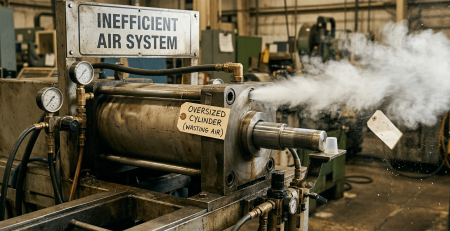
In an unmanaged plant, air leaks routinely consume 20% to 30% of the total compressor output. That means nearly a third of the money you spend running your compressor is literally vanishing into thin air.
Because the plant floor is noisy, these leaks go unnoticed until the weekend shift change.
- The Action Plan: Don’t treat leak detection as a once-a-year event. Equip your maintenance team with a portable ultrasonic leak detector. Create a visual “leak tag” system so technicians can log, prioritize, and patch leaks during scheduled PM cycles.
4. Tackle Pressure Drop (Fix the Plumbing)
If your compressor is pumping out 100 PSI, but your tools are only receiving 85 PSI, you are suffering from a severe pressure drop.
Technicians often “fix” this by cranking up the compressor pressure, which only increases energy costs and accelerates leak rates. Instead, fix the root causes of friction:
- Clogged, unserved FRL filter elements.
- Restrictive, undersized quick-disconnect couplers.
- Undersized overhead piping loops.
Your Weekend Compressed Air Audit Checklist
Ready to take action? Hand this quick compressed air audit checklist to your lead maintenance technician this Friday:
- [ ] Measure the baseline: Record the compressor’s energy consumption during a period of zero production (e.g., Sunday morning) to calculate your true leak load.
- [ ] Check the differential pressure: Inspect the gauges across all main inline filters; replace any element causing a drop greater than 3 to 5 PSI.
- [ ] Audit the demand side: Identify any point-of-use application using open-blow pipes and map them for smart nozzle upgrades.
- [ ] Isolate idle machinery: Ensure that machines not actively in production have their local air supply shut off via automated isolation valves.
Summary
- Compressed air is an efficiency money-pit: Only a fraction of the electricity used by a compressor translates into actual mechanical tool force.
- Drop the pressure, keep the cash: Lowering your header pressure by a mere 10 PSI trims roughly 5% off your compressor’s power bill.
- Ban open blow-offs: Replacing raw copper tubes with engineered smart nozzles dramatically cuts air consumption while maintaining blow-off force.
- Stop the silent bleeding: Implement a continuous ultrasonic leak detection program to recapture the 20%+ of air currently escaping your piping network.
Ready to Cut Your Facility’s Energy Waste?
Improving your plant’s pneumatic efficiency doesn’t require a massive capital expenditure budget. Often, it starts with replacing restrictive fittings, installing high-efficiency nozzles, or upgrading to premium, low-differential FRL assemblies.
At Pneumatic Now, we don’t just sell parts—we help you optimize your entire air loop to drive down utility overhead.